
Q-Chem Newsletter: January 26, 2026
January 28th, 2026

Q-Chem News & Events
Virtual Winter School on Computational Chemistry
Q-Chem is thrilled to be one of the sponsors for the 2026 Virtual Winter School on Computational Chemistry! This year's schedule includes many exciting talks and workshops, including two Q-Chem workshops! The meeting is online and free, making it a great opportunity for students and experts alike to learn and network. Learn more and register here.
Webinar: XCIS-CVS Spectroscopy (Avik Ojha)
Did you miss the Q-Chem webinar yesterday from Avik Ojha? If not, don't worry! The recording of his talk is now available on our YouTube channel here. ⧉ Watch to learn about his recent work implementing spectroscopy methods in Q-Chem, including the new XCIS-CVS implementation newly available in Q-Chem 6.4!
2026 Nick Besley Award Submissions Open
Do you know a Q-Chem user or developer who uses Q-Chem for computational spectroscopy? If so, please consider nominating them for the 2026 Nick Besley Award! For more information about eligibility and selection criteria, please click here. ⧉
Nominations should be sent to office@q-chem.com ⧉ with the subject "Besley Award Nomination" by January 31, 2026. The award winner will be announced soon thereafter.
Feature of the Month: Black-box "Robust SCF" Pipelines
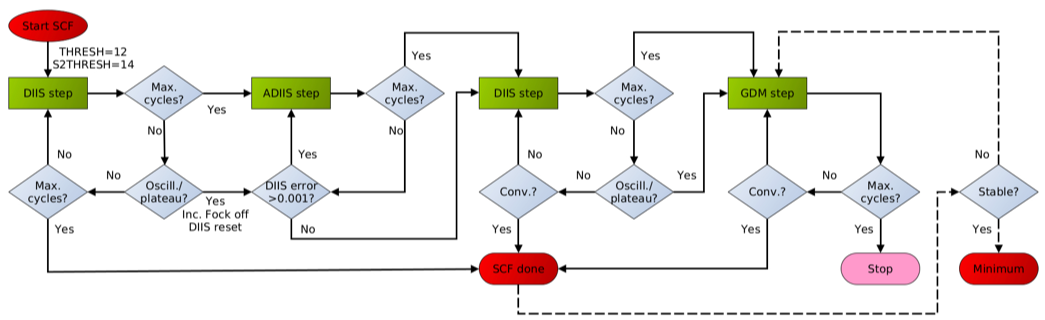
SCF convergence failure is a recurring problem for many computational chemists. Fiddling with algorithm and threshold settings can be frustrating and time-consuming, and can become a major bottleneck in research workflows.
Q-Chem now includes a new "Robust SCF" algorithm, which provides an easy black-box approach for reliable SCF convergence. It automatically detects common convergence issues, including plateauing, oscillation, and unstable solutions, and corrects them by selecting appropriate threshold and algorithm settings.
You can learn more about this new approach here. ⧉ It's now available in the latest Q-Chem release, so turn on the setting to try it out!
Recent Publication Highlights
Q-Chem In The Cloud: Modeling Nanosatellite Propellants on AWS
Ab initio simulations of dynamics of EMI-BF4 ionic liquid propellant used in electrospray thrusters for nanosatellite applications. ⧉ George Baffour Pipim, Kevin D. Sampson, Jose Torres, Noah Tingey, Kylar Flynn, Daniel Depew, Joseph Wang, Anna I. Krylov. J. Chem. Phys. 2025.
Nanosatellites have a broad range of applications, from scientific research to data communications, but improvements to their propulsion systems—key to getting them into orbit—are ongoing. In this recent collaborative publication, authors use AIMD to study the field-induced fragmentation of ionic liquid. Their work asks how and why fragmentation happens on a molecular level, providing data that can aid in the design of better, sturdier thrusters.
They use Q-Chem for the electronic structure calculations; several calculations were also performed using our new Q-Cloud tools, enabling calculations in the cloud on AWS! Click here to learn more about Q-Cloud.
Also, don't forget that funding opportunities for free compute time on AWS resources are also available! Opportunities are released periodically, so keep an eye on the AWS website for grants and application information.
BWs2.5: Third-Order Perturbation Theory Made Regular
Third-Order Perturbation Theory Made Regular: A Noniterative Correction to the Size-Consistent Second-Order Brillouin−Wigner Perturbation Theory. ⧉ Zhenling Wang, Yao Shen, Martin Head-Gordon. J. Phys. Chem. Lett. 2026.
In this exciting publication, Q-Chem developers at University of California Berkeley introduce BWs2.5, a noniterative third-order correction to BWs2. BWs2 provides a regular and size-consistent alternative to the widely-used MP2, overcoming the issues traditional Møller−Plesset approaches have with strongly-correlated systems.
Using a developer version of Q-Chem, authors implement and test their new BWs2.5 approach on several bond-breaking systems, demonstrating that it handles strong correlation well while providing improved accuracy over BWs2.
Interested in joining our Q-Chem developer community? Learn more here!
Analytic Gradients for EOM-DEA-CCSD and EOM-DIP-CCSD
Analytic gradients for EOM-DEA-CCSD and EOM-DIP-CCSD: Theory, implementation, and application to diradicals. ⧉ Tingting Zhao, Anna I. Krylov. J. Chem. Phys. 2026.
Check out this paper from Q-Chem developers at University of Southern California (Anna Krylov and Tingting Zhao), in which they derive and implement analytic nuclear gradients for EOM-DEA-CCSD and EOM-DIP-CCSD! This enables fast, accurate predictions of properties and geometries for excited and open-shell systems, and is particularly useful for diradical systems.
Their implementation is available in Q-Chem 6.4.
Additional Publication Highlights
For the most up-to-date paper highlights, follow us on LinkedIn ⧉ , X ⧉ , or BlueSky ⧉ ! Want to see your recent paper or preprint featured on our social media posts or in our newsletter? Submit suggestions using our new form here! ⧉